
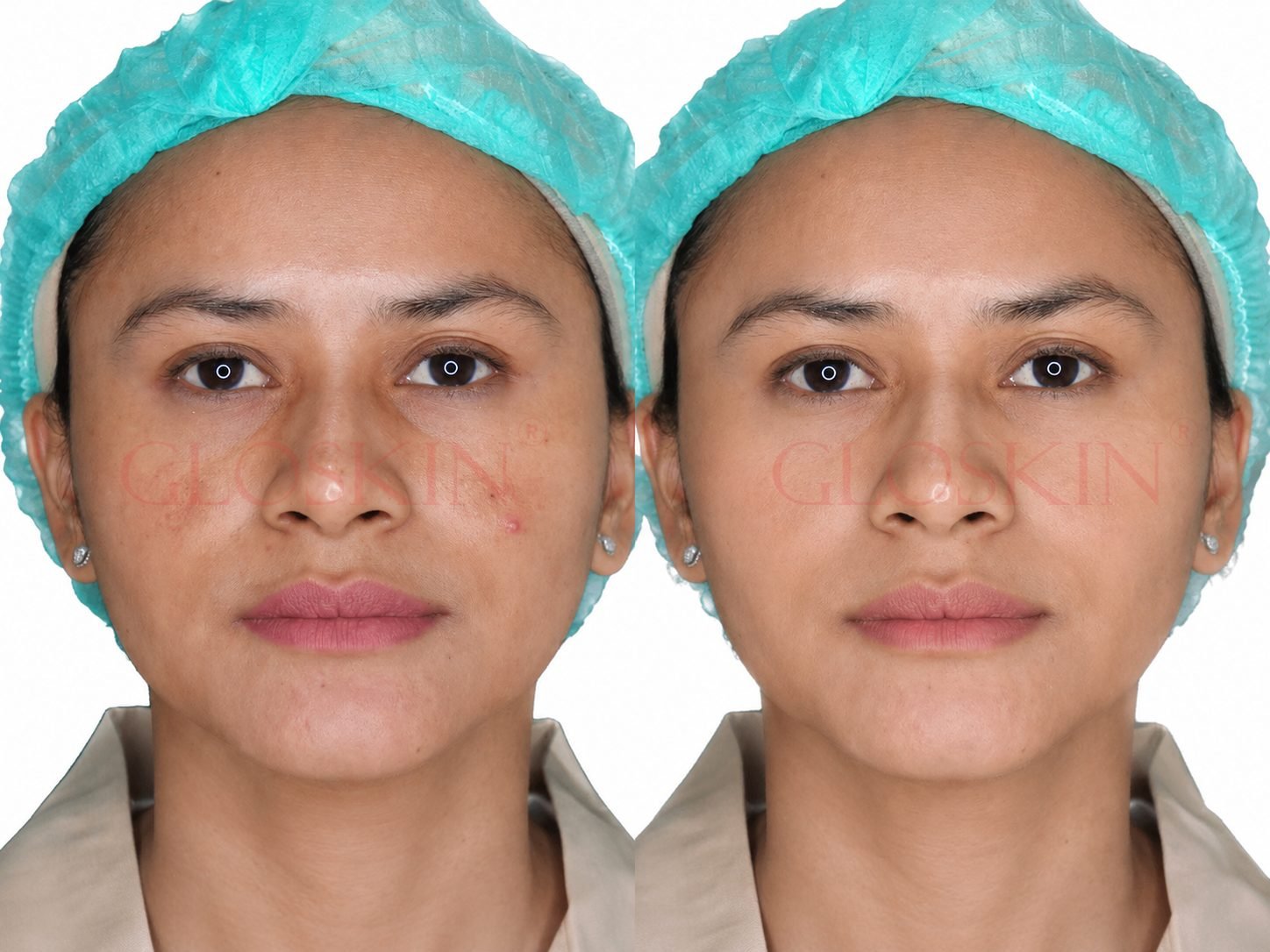
5G Helios Laser
What is 5G HELIOS Laser treatment?
5G Helios Laser is a treatment that helps fade spots and even out skin tone using the Helios III device with Fractional Q-Switched Nd:YAG technology.
The device has several mode options, so the doctor can adjust the treatment to the type of concern and your skin condition.
What concerns can it address?
5G HELIOS Laser can help with:
- Dark spots from sun exposure
- Freckles or brownish spots
- Lentigo or age spots
- Uneven skin tone
- Dull-looking skin
- Dark post-acne marks
- Post-inflammatory hyperpigmentation
- Melasma
- Visibly enlarged pores
- Uneven skin texture
- Acne scars
- Fine wrinkles
- Black tattoos and some other tattoo colors
How does it work?
5G HELIOS Laser delivers targeted light energy to melanin pigment or tattoo ink. The energy produces photoacoustic and photothermal effects that help break pigment into smaller particles. The pigment particles are then cleared gradually by the body.
Who is it suitable for?
This treatment can be considered for patients who:
- Have spots or pigmentation
- Have dull-looking skin
- Have uneven skin tone
- Have dark post-acne marks
- Have large pores or less smooth texture
- Have early signs of aging
- Have a tattoo they want to fade
- Want skin treatment with relatively minimal downtime
- Need a laser program that can be adjusted to their skin condition
Patients with melasma need special handling, and results need to be maintained with sunscreen, skincare, control of triggering factors, and follow-up care.
How long does the procedure take, and what is recovery like?
The treatment generally takes about 20-45 minutes not including preparation, depending on the size of the area and the skin concern treated.
Recovery differs by treatment mode:
- Laser toning: mild redness for a few hours up to 1-3 days. Light activities can be continued if comfortable.
- Spot pigment: Spots may darken or crust for about 7-14 days. Let them fall off on their own.
- Fractional treatment: Redness, warmth, or rough-feeling skin can last about 1-5 days; longer if the intensity is higher.
- Tattoo removal: Swelling or redness in the first days; wounds or crusts can take about 7-14 days or more to recover.
How many sessions are needed?
The number of treatments is adjusted to the indication and your skin’s response.
In general:
- Laser toning and brightening: about 3-6 sessions, about 4 weeks apart, followed by evaluation
- Certain spots or pigmentation: about 1-4 sessions, 4 weeks apart, followed by evaluation
- Pores and skin rejuvenation: about 3-6 sessions, 4 weeks apart, followed by evaluation
- Melasma: needs a gradual, controlled program with combination treatments.
- Tattoo removal: may need about 5-10 sessions or more, 4-8 weeks apart, followed by evaluation
When will results start to show?
Progress differs for each skin concern.
- Skin can look brighter after a few days to a few weeks.
- Uneven skin tone improves gradually after several sessions.
- Melasma may show changes after 3-12 months with combination treatments.
- Dark post-acne marks reduce gradually.
- Pores and skin texture start to improve after 8-12 weeks with combination treatments.
- Collagen formation can keep developing over several weeks to several months.
- Tattoos fade gradually after each session.
Pigmentation results are not always permanent because spots can come back due to sun exposure, hormones, inflammation, genetics, and the use of skin-irritating products.
Does it need to be combined with other treatments?
5G HELIOS Laser can be combined with other treatments according to your skin condition, such as:
- Subcision, for acne scars that pull inward
- TCA CROSS, for certain types of acne scars
- Skin booster or Salmon DNA, to improve hydration and skin quality
- Facial Therapy, to help keep the skin clean and healthy
- LHA Peel, to care for the skin surface; avoid adding irritation while the skin has not yet recovered.
- XelaRederm / SKINVIVE / CROMA, helps hydration and skin quality; not a substitute for pigment therapy.
Combinations are not always done on the same day. The doctor will decide a safe order and spacing so the skin does not become overly irritated.
Things to note before and after treatment
Before treatment
- Avoid excessive sun exposure and sunburn.
- Use sunscreen regularly.
- Tell us about the medications and skincare you are using.
- Mention if you use retinoids, photosensitizing medication, or blood thinners.
- Tell us about any history of keloids, herpes, light-triggered seizures, and wound-healing disorders.
- Share any previous laser or peeling history.
- Treatment needs to be postponed if there is an infection, open wound, or active inflammation.
- Tell us if you are pregnant or breastfeeding.
- Stop certain active ingredients only if your doctor advises it.
After treatment
- Use a gentle cleanser and moisturizer.
- Use sunscreen of at least SPF 30 and reapply it.
- Avoid direct sun exposure.
- Do not rub or forcibly peel off crusts.
- Avoid scrubs, retinoids, peels, and irritating skincare until the skin has recovered.
- Avoid saunas, hot water, and heavy exercise for 24-48 hours or as directed.
- Do not use whitening creams or medication without your doctor’s recommendation.
- Follow the check-up schedule and aftercare from GLOSKIN.
Consult with a GLOSKIN doctor
Not all spots have the same type and depth. A doctor’s examination is needed to tell apart pigmentation that can be treated with laser from conditions that need another approach, as well as differences in cause, depth, and response to laser. Choosing a wavelength or energy that is not suitable can cause irritation, burns, hyperpigmentation, or hypopigmentation.